
Volcanic Ash: A Unique Carbon Capture and Land Degradation Solution
While atmospheric carbon rightfully holds much of the spotlight in climate change discussions, climate change also exacerbates the often overlooked issue of land degradation, which the UN Food and Agriculture Organization describes as a “silent crisis” threatening food stability and agriculture across the globe.
In Tajikistan, 70% of arable land has shown signs of degradation, despite 70% of the country’s population relying on agriculture for income. The Mekong Delta in Vietnam, commonly referred to as the ‘rice bowl’, has seen saline soils (high in salt) go from an uncommon occurrence to a regular threat to the food supply. In the Maldives, where arable land is scarce, soil salinization further threatens an already vulnerable agricultural system. In the United States, saltwater has already intruded into aquifers in 43 states and Southeast farmers are already grappling with decreased crop yields due to increased salinity.
Overall, saline soils impact over a billion hectares of land globally (about 10% of the world’s total land). The impacts of a changing climate, with the sea-level rise and increased evaporation it brings, will likely worsen these impacts over time.
While remineralization has shown the ability to sequester carbon and improve agricultural yields, its effectiveness and impact on highly saline soils represents a significant data gap in remineralization research. Many remineralization studies focus on the application of widely available rocks such as basalt, however in recent years, volcanic ash has emerged as another potential form of “rock dust” due in part to its surface area, extremely low organic carbon content, and high ability to form carbon complexes. These features make volcanic ash a viable but understudied potential carbon sink. But similar to basalt, most studies have been completed in acidic soils rather than saline soils.
A recent study fills the gap
A study from 2024, carried out by a four person research team at Shenyang University in China, addresses these issues and more. By measuring the impacts of volcanic ash on soil quality, plant growth, and carbon sequestration, the researchers aimed to evaluate three hypotheses:
- That volcanic ash can sequester carbon in saline soils,
- That applications can enhance silicate rock weathering, and
- That volcanic ash can act as a soil conditioner for crops planted in these soils.
The 6-month growth experiment provides key insights into effective carbon capture and land quality improvement.
Sheyang is in Northeast China, an arid region where saline soils are widespread: inland saline soils cover around 5 million hectares of land. The research team sourced soil for their experiment from saline farmland in Tongyu County in the western Jilin Province, an agricultural community which faces significant land degradation issues (like salinization and alkalization).
The soils used were found to have a high pH (>10), with primarily sandy and silty composition, and relatively low organic matter (2.34g/kg, which is common in saline soils).
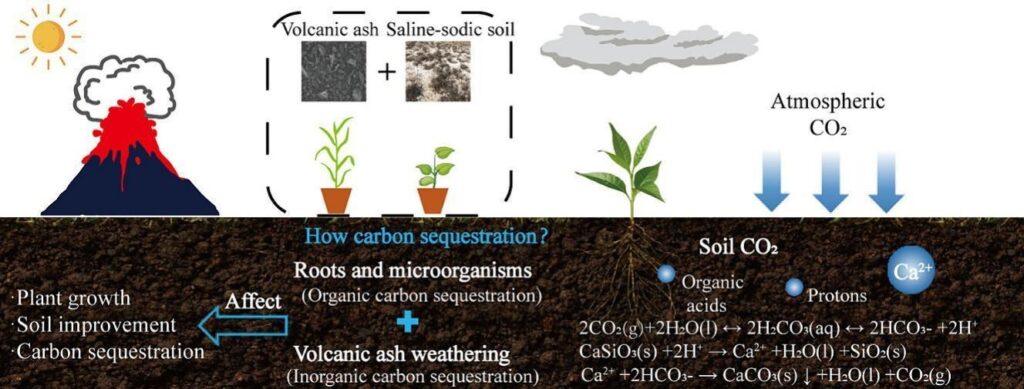
Volcanic ash was sourced from the Shuangu Peak, also located in Jilin Province, and analyzed via X-ray diffraction to assess suitability. The ash was found to contain multiple minerals, little to no organic carbon, and a pH just below 7.
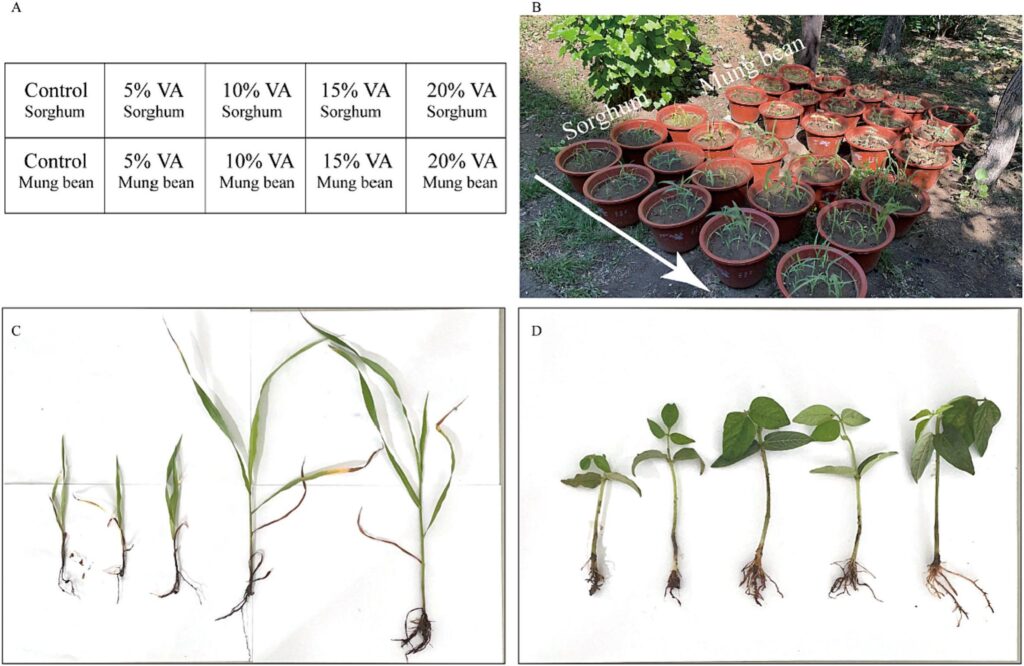
Once volcanic ash and saline soils were acquired, plastic pots were filled with soil, and each was treated with one of five concentrations of volcanic ash: 5%, 10%, 15%, or 20% with a control at 0%. Two crops commonly cultivated in the region (sorghum and mungbean) were then planted in the pots to test the impacts of volcanic ash on plant growth. Each pot was planted with 20 seeds of either species and cultivated under ‘semi-natural’ conditions.
To determine how soil health and plant growth were impacted, the researchers used a variety of mineralogical and biological techniques, such as elemental analysis, biomass carbon analysis, and measuring the amount of calcium carbonate accumulation—an important part of rock weathering. Researchers then measured the impacts of volcanic ash application through changes in plant growth and soil characteristics associated with soil quality and carbon capture.
The study results
The study revealed that sorghum planted in soils treated with 20% volcanic ash was capable of sequestering carbon at a rate of 1.4 metric tons of CO2 per hectare per month over the course of the experiment. This was achieved mainly through the formation of calcite, which formed within months during the study, yet can keep carbon out of the atmosphere for thousands of years.
The amount of carbon sequestered by more common rocks, such as basalt, varies widely. However, the data gathered by the researchers in Sheyang is comparable to those found in similar basalt studies. Scaled up over a year, under the same conditions, sorghum volcanic ash-amended soils would have the capacity to sequester nearly 17 metric tons CO2 per hectare.
In addition to carbon sequestration, volcanic ash acted as a soil conditioner mitigating several of the deleterious impacts of soil salinization. For sorghum planted soil, the rate of sodium adsorption dropped by 57% and alkalinity decreased by 67%. Soil pH further decreased significantly over the course of the 6-month experiment. A similar reaction was observed in mungbean planted soils, indicating that soil quality was improved by the application of volcanic ash.
Plants also appeared to benefit from the volcanic ash amendment. Growth of both mungbean and sorghum plants increased by 10% after the application of volcanic ash. For mungbeans, there was a 41% increase to plant height. Plant growth further spurs a positive feedback loop, as carbon in soil fosters additional nutrient release.
Conclusion
To mitigate the impacts of climate change, studies estimate that we must sequester 2 to 10 Gt of CO2each year by 2050, an urgent goal with a deadline in 24 years. Due to the comorbid issue of land degradation, increasing the carbon storage capacity of saline, organically depleted soils is of high priority. The synergistic advantage of soil conditioning and increased crop growth brought about by volcanic ash represents a viable solution to two of the most pressing climate issues today.
Bayleigh Murray is an environmental data analyst and science writer based in South Carolina, U.S.A. She has a research background in microbial ecology and a professional background in environmental assessments. She holds a B.S. in Molecular & Cellular Biology and Earth & Planetary Sciences from Johns Hopkins University and has written and edited popular science features for the Johns Hopkins News-Letter and the Triple Helix Science and Society Review. She is an avid blogger and is passionate about exploring the intersections of science and culture.

Support us on Patreon
Thank you for joining us today! Please become a member of RTE and support us on Patreon. Unlike many larger organizations, we work with a team of determined and passionate volunteers to get our message out. We aim to continue to increase the awareness of remineralization to initiate projects across the globe that remineralize soils, grow nutrient dense food, regenerate our forests’ and stabilize the climate – with your help! If you can, please support us on a monthly basis from just $2, rest assured that you are making a big impact every single month in support of our mission. Thank you!
- S Prev
- s


Got something to say?