
Resilient Cacao Emerges Through Enhanced Weathering Strategies
Cacao’s climate footprint is far larger than most consumers imagine, and incremental efficiency gains will not be enough to secure the crop’s future. A new paper in the journal Plants, People, Planet proposes a dual strategy: agroforestry for resilience and enhanced rock weathering (ERW) for carbon removal. However, it remains to be seen how scientific promise intersects with institutional constraints.
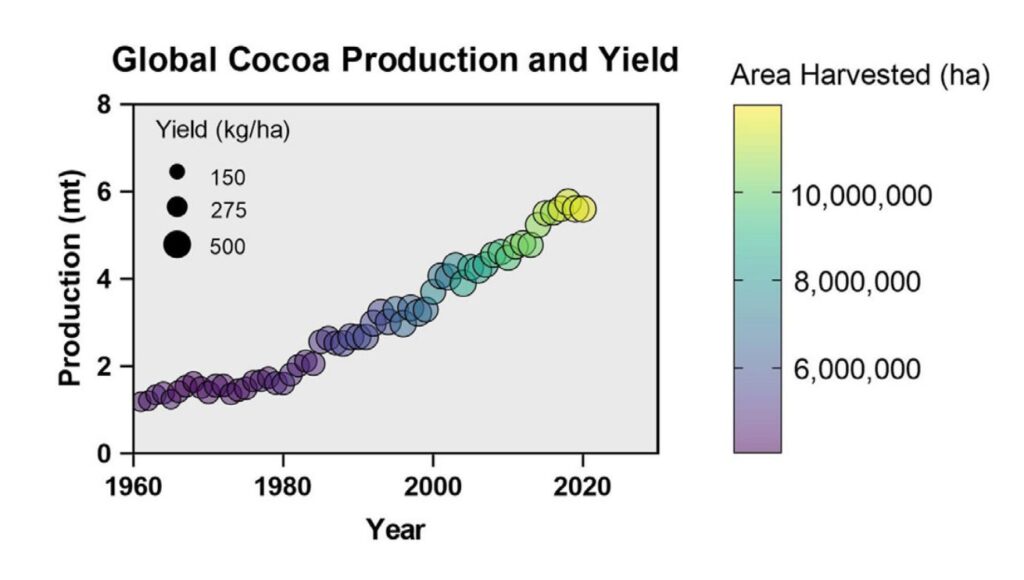
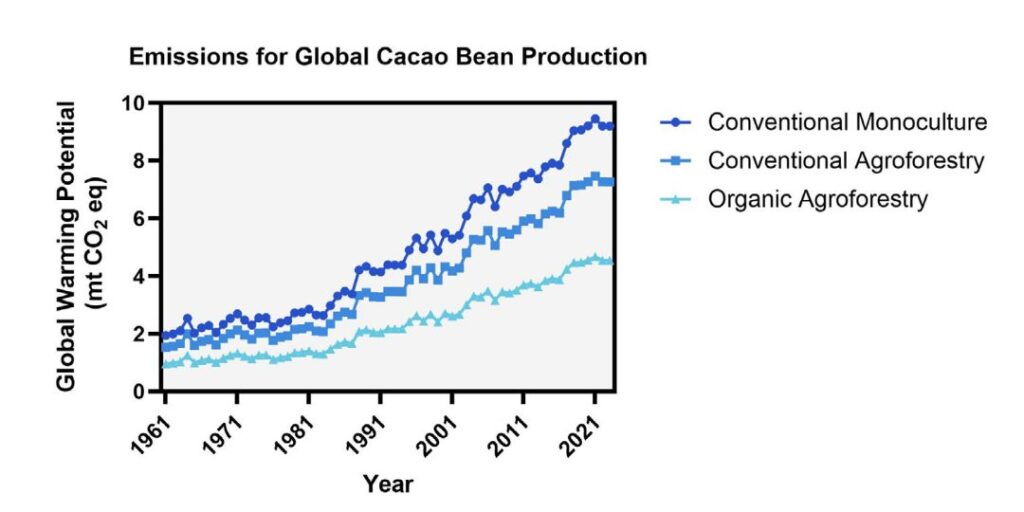
The paper begins with an overlooked but fundamental point: chocolate is a high-emissions commodity. Fertilizer-intensive cultivation contributes up to 96.7% of smallholder cacao system emissions, underscoring the limitations of treating yield improvement as a climate strategy. Deforestation linked to cacao expansion can raise per-kilogram emissions severalfold, and in some regions land-use change alone accounts for nearly all production-phase emissions. The authors argue that genuine alignment with global climate goals requires combining resilience with carbon dioxide removal, instead of choosing between them.
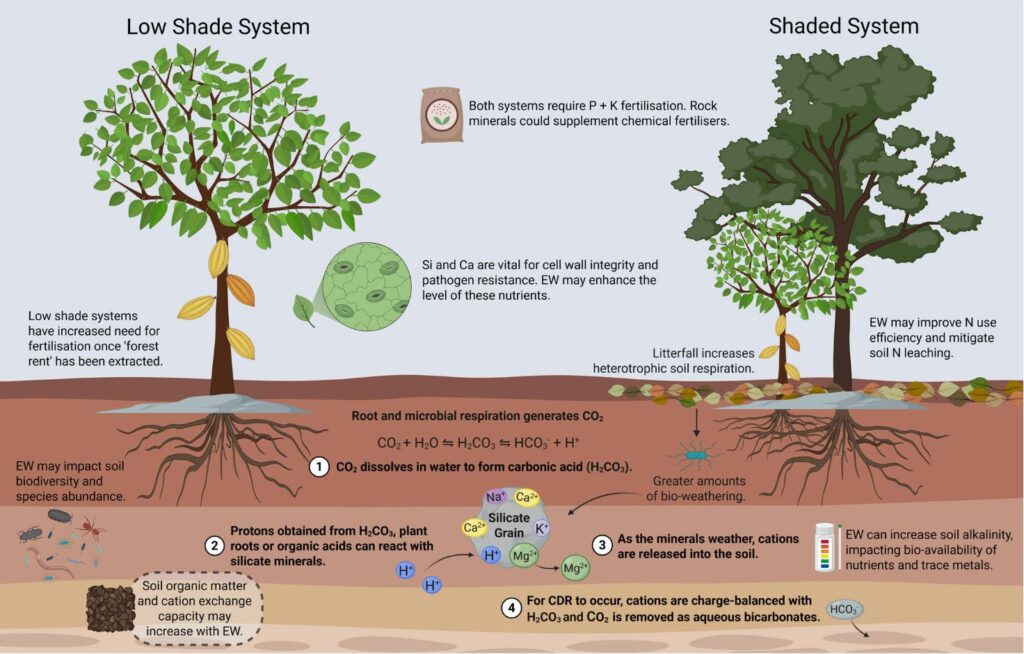
The first half of the study examines agroforestry and its ability to stabilize cacao production under accelerating climate stress. As a naturally shade-tolerant understory species, cacao benefits from diversified, multi-layered canopies that reduce heat, increase humidity, and lower pest pressures. Shade can lower daily temperature swings and increase humidity, forming a more reliable microclimate. Carbon benefits are substantial as well: low-shade agroforests store more than double the above-ground carbon of monocultures, and multi-strata systems climb even higher.
Agroforestry also intersects with national regulatory systems, especially where cacao is considered a native species. In Brazil, the Forest Code allows cacao to be incorporated into ecological restoration, enabling compliance with land-use requirements while sustaining production. Establishing agroforestry with cacao on previously cleared land can prevent significant carbon losses compared to targeting newly deforested areas. Adoption, however, remains uneven due to concerns about shade-related yield reductions and a lack of technical support for managing trade-offs between diversity and productivity.
The second half of the study introduces enhanced rock weathering as a complementary pathway. Finely ground silicate rocks such as basalt dissolve faster in acidic, biologically active soils, raising pH, releasing nutrients, and potentially sequestering CO₂ as bicarbonate. For cacao systems burdened by soil acidity and aluminum toxicity, ERW offers tangible agronomic gains. Experiments in acidic Oxisols show higher pH, reduced exchangeable aluminum, and increased cacao biomass under moderate application levels.
Evidence for ERW’s carbon removal potential remains early but promising. Field trials in Malaysia suggest roughly 1 ton of CO₂ removal per hectare over three years, while experiments from Costa Rica estimate higher rates at elevated application levels. Using these bounds, the authors model scenarios in which ERW is applied to 10% of global cacao area, finding that it could meaningfully offset production-phase emissions in fertilizer-dependent regions. Still, most ERW studies span only a few years, leaving long-term performance uncertain.
At the feasibility stage, promising science runs up against practical system limits. For example, emissions from moving rock powder greater distances can negate climate benefits. The authors propose using existing lime supply chains and mining by-products to reduce costs and logistical burdens. They also highlight trace metal risks and dust exposure during application, which are issues that require regulatory frameworks many cacao-producing countries do not yet possess.
Institutional gaps emerge as the study’s most significant unresolved challenge. Much of the positive evidence comes from Brazil, where remineralizers have a defined regulatory category and supply chains are well established. In contrast, most cacao-producing regions in West Africa and Southeast Asia lack clear legal classifications or incentive structures for mineral amendments. Without these, ERW cannot scale beyond isolated research sites.
The socioeconomic dimension introduces another fragility. Smallholders, who produce the majority of global cacao, often face cash-flow constraints and commodity-price volatility. Asking them to purchase rock powders, manage transport, and wait for uncertain carbon-credit revenues introduces risks. In this context, adoption will hinge less on geochemistry than on whether ERW fits within farmers’ economic realities. For this reason, large organizations like Flux, Mati Carbon and InPlanet take on the risks, covering the cost of rock dust for smallholder farmers in exchange for carbon credits.
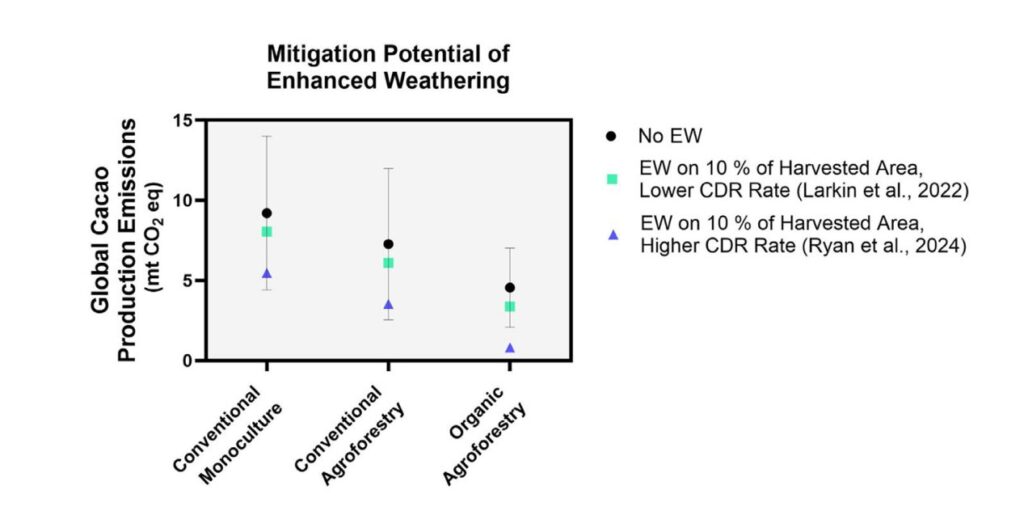
Ecological uncertainty also remains an issue. Beyond trace metals and dust, large mineral inputs can alter nutrient cycling and plant-soil feedback in unpredictable ways, particularly within diverse agroforestry systems. The paper highlights potential benefits but leaves open important questions about monitoring thresholds and indicators for ecological change.
“The integration of ERW and agroforestry could offer a scalable solution to align cacao production with global climate and sustainability goals while supporting long-term agricultural resilience.”
Steeley et al. (2025)
Overall, the study offers a scientifically grounded and forward-looking vision. It challenges the long-standing divide between adaptation and mitigation, presenting a dual strategy for stabilizing cacao under climate change. Yet scientific plausibility is only the first step. Its realization ultimately depends on governance, design and smallholder inclusion.
A viable pathway forward will require progress along three fronts: long-term field trials embedded in real farming conditions; regulatory frameworks that monitor mineral amendments; and participatory models that position smallholders as co-designers. If these elements align, agroforestry and ERW can operate as a practical dual strategy rather than a theoretical and aspirational pairing. Fortunately, companies, organizations and governments around the world have already begun this work.
The future of cacao will not be decided by chemistry or ecology alone, but by whether agricultural, regulatory, and economic systems are willing to evolve fast enough to meet the climate challenges that are already arriving.
Qi Zheng is an undergraduate student in Environmental Policy and Sustainable Development with Economics at the London School of Economics and Political Science. She is interested in climate policy, soil carbon sequestration, and sustainable land management, and is also exploring the intersections of environmental governance and economic development.
Support us on Patreon
Thank you for joining us today! Please become a member of RTE and support us on Patreon. Unlike many larger organizations, we work with a team of determined and passionate volunteers to get our message out. We aim to continue to increase the awareness of remineralization to initiate projects across the globe that remineralize soils, grow nutrient dense food, regenerate our forests’ and stabilize the climate – with your help! If you can, please support us on a monthly basis from just $2, rest assured that you are making a big impact every single month in support of our mission. Thank you!


Prof. Rafael M. Santos
January 7, 2026 (1:33 pm)
Basalt is often mentioned as a good candidate for enhanced rock weathering, but it is important to recognize that “basalt” is a very broad term. Basalts vary widely in their mineral composition and texture, and these differences affect how quickly they weather and how much benefit they provide to soils. Some basalts are rich in minerals that dissolve readily and help raise soil pH, while others contain phases that are much more resistant. Treating all basalts as equal could lead to sourcing rocks that do not deliver the expected carbon removal or agronomic improvements.
Another point that needs clarification is what “finely ground” means. Crushing rock to a smaller size is practical and helps expose more surface area, but milling to an extremely fine powder can be energy-intensive and costly. Basalt is a hard material, so achieving very fine sizes requires significant effort. If very fine milling is necessary to overcome the problem of reactive surfaces being hidden inside the particles, that becomes a limitation for large-scale use. Our research on particle-scale morphology and reactive surface area shows that the way minerals are exposed matters as much as the overall size, and this should be considered when planning enhanced weathering projects.
Better characterization of basalt and clearer guidance on particle size will help farmers and suppliers make informed decisions. This will ensure that enhanced rock weathering delivers both climate and soil benefits without unnecessary costs or unintended outcomes.